
A staff member opens what looks like a routine invoice, a laptop misses a critical update, or an employee signs in from an unfamiliar network. For many businesses, the endpoint protection versus antivirus decision becomes urgent only after one of these ordinary moments turns into downtime, data exposure, or a costly recovery effort. The right choice is not about buying the most features. It is about protecting the devices, people, and information your organization relies on to operate.
Antivirus still has a place, particularly as a basic layer of defense. But most organizations now face threats that do not behave like the viruses antivirus tools were originally designed to catch. Ransomware, credential theft, phishing, unmanaged devices, and attacks that move across a network require broader visibility and a faster response.
What Antivirus Does Well
Traditional antivirus software is designed to identify and block known malicious files. It scans a computer for suspicious code, compares files against known threat signatures, and quarantines malware when it finds a match. Modern antivirus products may also use behavioral detection and cloud-based threat intelligence, which makes them more capable than older, signature-only tools.
For a very small organization with limited data, few devices, and simple operations, antivirus can be a reasonable starting point. It helps prevent common threats such as malicious downloads, infected attachments, and unwanted software. It is also familiar, relatively easy to deploy, and usually inexpensive.
The limitation is scope. Antivirus primarily focuses on malware on an individual device. It may tell you that it removed a suspicious file, but it often does not provide a complete picture of how that file arrived, whether credentials were compromised, whether other devices are affected, or what should happen next.
That gap matters when a single compromised laptop can provide access to cloud applications, shared files, financial systems, client records, or network resources.
Endpoint Protection Versus Antivirus: The Core Difference
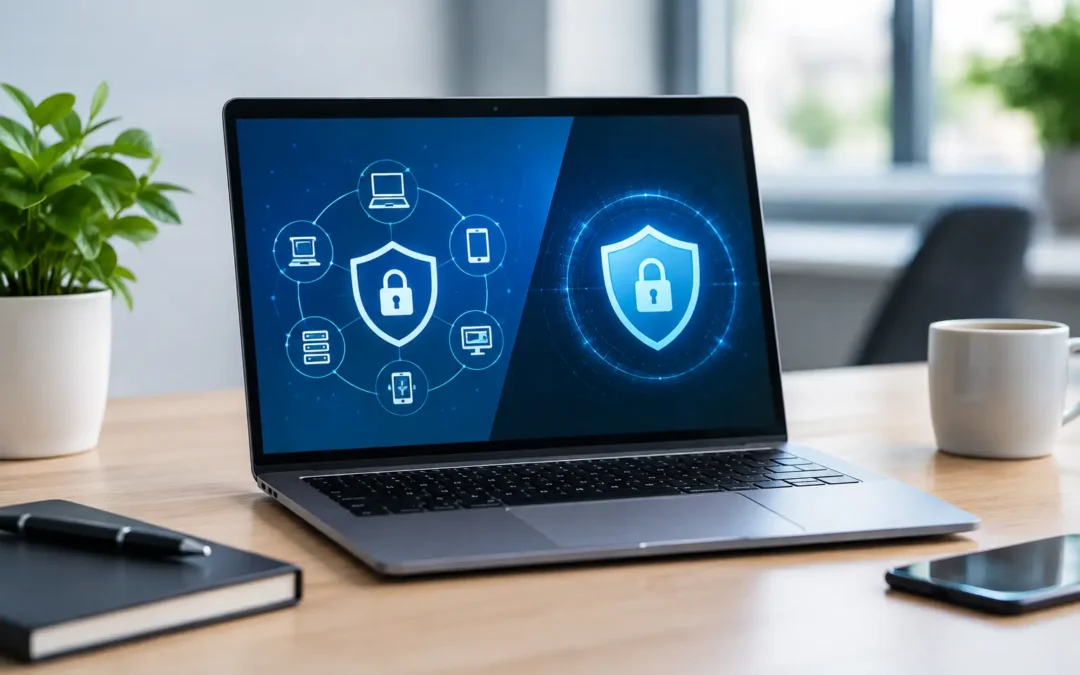
Endpoint protection is a broader security approach for the computers, servers, mobile devices, and other connected equipment that access your business environment. An endpoint protection platform typically combines prevention, monitoring, detection, and response capabilities in one managed system.
Rather than only looking for a malicious file, endpoint protection evaluates activity. It can detect unusual behavior, such as a user account logging in from an unexpected location, a process attempting to encrypt large numbers of files, or a device communicating with a known malicious service. It can also isolate an affected endpoint to help stop an incident from spreading while the issue is investigated.
The distinction is practical. Antivirus asks, “Is this file known to be harmful?” Endpoint protection also asks, “Is this device behaving in a way that puts the business at risk?”
For a business decision-maker, that means endpoint protection is less about another software license and more about reducing the likelihood that a routine security event becomes an operational crisis.
Visibility changes the response
When a threat is detected, speed matters. A basic antivirus alert may require someone to determine which device is affected, whether the alert was real, and whether other systems need attention. That can be difficult for an office manager or internal employee who already has a full-time job.
Endpoint protection can centralize device status, security alerts, software information, and incident activity. When paired with active monitoring and experienced IT support, it gives your organization a clearer path from detection to response. The goal is not merely to receive more alerts. It is to receive meaningful action before an issue disrupts operations.
Endpoint protection supports business continuity
Security incidents are also continuity incidents. If ransomware encrypts shared files or a compromised device spreads across the network, staff may be unable to serve clients, access records, process transactions, or meet deadlines.
Endpoint protection helps reduce this exposure through behavioral threat detection, device isolation, automated response actions, and centralized security policies. It works best alongside layered protections such as secure email, multifactor authentication, patch management, backups, user training, and network security. No single tool eliminates risk, but coordinated controls make an attack much harder to execute and recover from.
Where Antivirus Alone Can Fall Short
Antivirus may be insufficient when your business stores sensitive data, supports remote or hybrid staff, relies on cloud applications, or has compliance responsibilities. These conditions are common for healthcare practices, legal firms, financial organizations, engineering companies, nonprofits, and other organizations that cannot afford extended downtime or uncertainty around a security event.
It can also fall short when devices are not consistently updated and monitored. A security tool is only one part of the equation. If operating systems, browsers, and business applications remain unpatched, attackers may exploit weaknesses without needing to install the kind of malware a traditional antivirus product recognizes.
Another concern is alert ownership. If antivirus flags a threat at 2:00 a.m., who sees it? Who can decide whether to isolate a device, reset credentials, review access logs, and verify that backups are safe? Businesses do not need to build a large internal security department to answer these questions, but they do need a documented and dependable response process.
How to Choose the Right Level of Protection
The best choice depends on your operations, risk tolerance, and internal resources. A five-person office with minimal sensitive data has different needs than a 100-user firm with remote employees, regulated information, and multiple business-critical applications.
Start by considering what would happen if one employee device were compromised. Could that person access customer information, financial records, shared drives, email, or administrative systems? Would the incident interrupt operations for hours, days, or longer? Could your team identify the affected device and respond quickly?
Then look at the environment as a whole. Businesses should account for laptops used outside the office, personal devices that access company data, servers, cloud applications, and third-party access. The more distributed the environment, the more valuable centralized endpoint visibility becomes.
Cost should be evaluated in business terms. Basic antivirus may have a lower monthly price, but the least expensive security tool is not always the lower-cost decision. A single ransomware event, fraudulent payment, or prolonged outage can outweigh years of savings. Endpoint protection is generally a stronger fit when the cost of disruption is meaningful.
Technology Is Only Part of the Security Plan
Even the best endpoint platform cannot compensate for weak passwords, missing updates, overly broad access permissions, or employees who have not been trained to recognize phishing attempts. Security works best when technology and process reinforce one another.
That is why many Central Florida businesses choose a managed IT partner to oversee protection as part of a broader plan. ITIT helps organizations align endpoint security with patching, backups, email protection, access controls, and practical incident response planning. This approach gives leaders a single accountable resource for both everyday support and longer-term risk reduction.
A useful security review should identify what devices you have, who manages them, what data they can access, and what happens when an alert occurs. It should also clarify whether the protection in place is actively monitored or simply installed and left to run.
The Better Question to Ask
Instead of asking whether endpoint protection is better than antivirus, ask whether your current security can detect, contain, and support recovery from the threats most likely to affect your organization. For some small environments, antivirus may be an acceptable baseline. For most growing businesses, endpoint protection provides the visibility and response capabilities needed to operate with greater confidence.
The practical next step is to review your devices, data exposure, and response responsibilities before an incident forces the decision. Security should support the way your business works, protect the trust you have earned, and keep technology from becoming a source of avoidable stress.